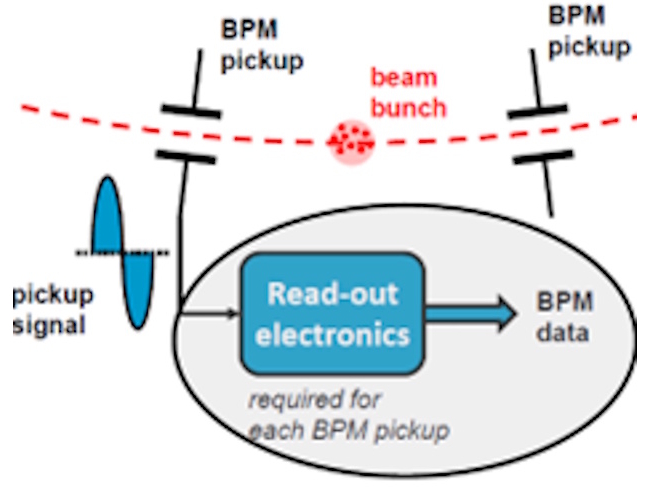
Beam Position Monitor Principle (Figure 1)
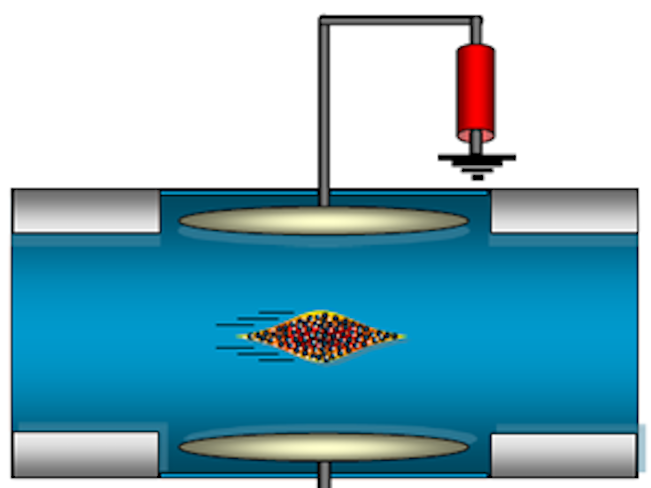
BPMs are non-invasive detectors located along the accelerator that are sensitive to the electromagnetic field of the passing beam. The BPM`s symmetrically arranged electrodes detect beam position by identifying asymmetries in the signal amplitudes (Figure 2).
|
|
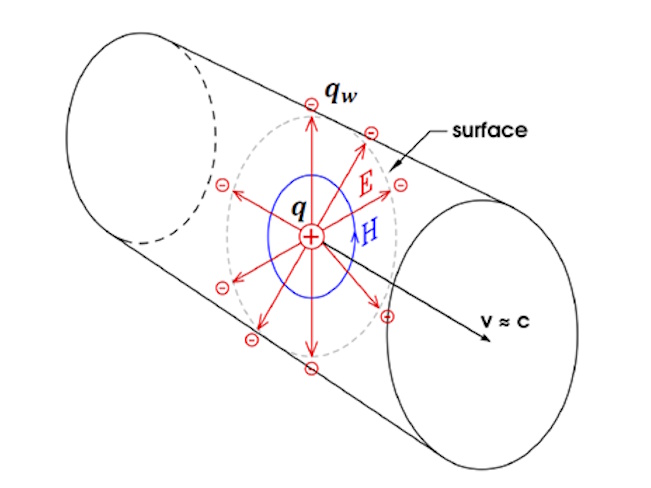
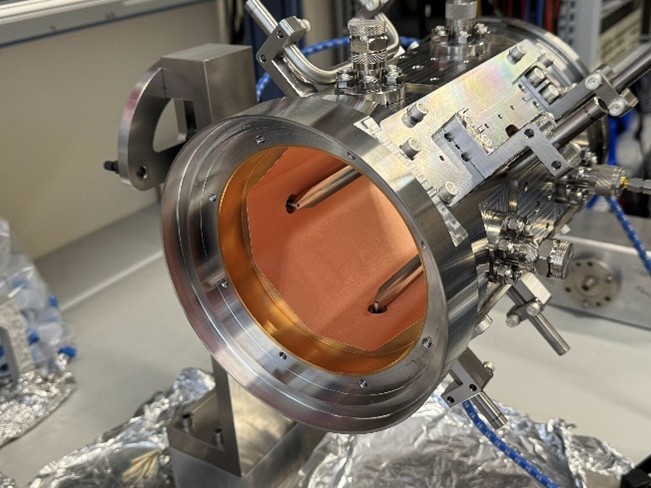
Figure 3 shows a single proton in the LHC, confined within a perfectly conducting cylindrical beam pipe of radius 𝒓, along with the associated electric and magnetic fields. In operation, bunches of billions of protons are launched. Each bunch passes between the electrodes in less than 2 ns, with the next bunch following just 25 ns later. The required spatial resolution is 10 μm (RMS transverse beam size is 7 μm). These beam dynamics dictate the specifications for the entire signal transmission chain (detector electrode, feedthroughs, transmission lines) and the downstream electronics. Figure 4 shows a BPM vacuum tube with two of the four electrodes, ready for testing at CERN’s Beam Instrumentation Laboratory.
|
|
BC-TECH technical expertise
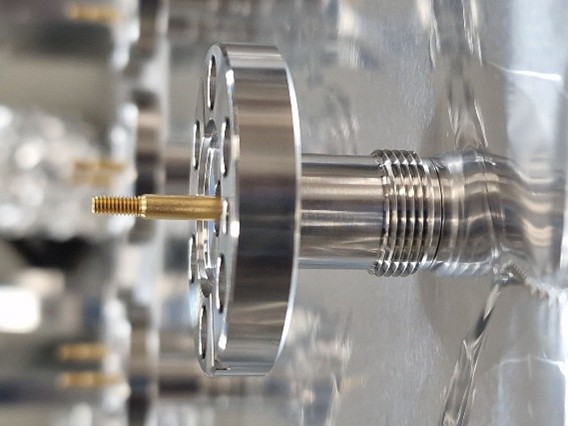
The high radiation environment of the LHC prevents any polymeric or ceramic material to be used as insulator material for vacuum feedthroughs. This is where the glass-to-metal technology from BC-TECH comes into play. The company’s expertise lies in the capacity, around high precision machined mechanical parts, to join glass (Boron-Silicate) and metal for a stable, pressure-resistant and chemically resistant component.
Under the LHC extreme temperature gradients – 200°C (beam tube operation level) to 300°C (vacuum baking), glass and metals would expand and contract at different rates (thermal expansion coefficient) with the risk of internal stress developing, leading to cracks in the glass or failure at the interface.
In addition, a special metal surface treatment is required. A 5 µm electroplated nickel–gold alloy is applied to improve conductivity and wear durability.
To be comptabible with the extreme Ultra High Vacuum (UHV) LHC conditions (10 -11 mbar), all feedthrough components are dry-machined, i.e., without conventional machine lubrication such as oil or other products incompatible with a UHV operating environment. Finally, adequate protection of all feedthrough components is required to maintain cleanliness. This implies, in particular, the absence of hydrocarbon traces and of organic or inorganic residues from grinding or handling. To this end, wearing clean, halogen-free plastic gloves at all handling steps is mandatory.
The initial contract concerns the supply of 370 UHV coaxial Radiofrequency (RF) feedthroughs. The total CERN demand for the LHC-HL project is estimated at 1000 units.
BC-TECH indicates that not only the technological and quality standards of the company resulted in the cooperation with CERN, but also the flexibility in understanding and transforming a design made by CERN into an industrial product. Thanks to the CERN reference, BC-TECH can continue to offer its products for other European accelerator upgrade programs such as ALBA (Spain) and ELETTRA (Italy).
Electronics by KNOWLEDGE RESOURCES
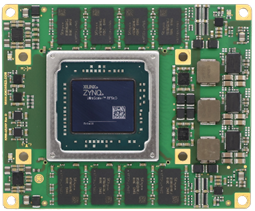
CERN's large-scale LHC facility, with measurement points physically separated from the control electronics by long-distance cabling, requires cutting-edge methods to accurately transmit particle-beam position data. Given the stringent real-time processing and data bandwidth requirements (6 GHz, according to beam dynamics – see above), a Field Programmable Gate Array (FPGA) -based approach was chosen.
Leveraging the know-how built up over time in various departments in FPGA design and code infrastructure, CERN favored a System-on-Module (SoM) solution based on an AMD Radio Frequency System on Chip (RFSoCs ). This allowed the team to focus on application-specific features rather than on the basic interface. The fully integrated analog circuit, with high-speed Analog to Digital Converters (ADCs) and Digital to Analog Converters (DACs), significantly simplifies the design challenges related to extreme sampling rates.
KNOWLEDGE RESOURCES, which has offered this type of SoM in its standard portfolio for many years, provided a mature, thoroughly tested module off-the-shelf (internal name KRM-4ZU47DR), that helped keep the project on schedule. The availability of comprehensive examples and the evaluation carrier’s shared board design data, along with effective support, were additional advantages that aided in tailoring customized solutions. Furthermore, the early delivery of the modules allowed acceptance testing of the BPMs to begin ahead of schedule.

About BC TECH AG

BC-TECH AG is a Swiss high-tech industrial firm focused on developing and manufacturing hermetically sealed components. Located in Domat/Ems (Graubünden), the company has 70 employees and brings over 30 years of expertise in precision engineering. It is best known for its glass-to-metal feedthroughs, which ensure vacuum-tight and pressure-resistant electrical connections.
These components can withstand extreme conditions, including temperatures up to 450°C and pressures up to 4,000 bar. Key industries served include Aerospace, Oil & Gas (drilling and refining), Medical Technology (ventilators and dental equipment), and Vacuum Technology.
BC-TECH operates a comprehensive mechanical production facility that supports its feedthrough production with more than twenty high-quality CNC turning and milling machines for complex geometries. Third-party services include spark erosion for hard materials, precise laser marking with advanced machinery, electroplating (galvanizing), and cable assembly for the feedthroughs.

Christian Bargähr
CEO
BC-TECH AG
Domat/Ems- Switzerland

About Knowledge Resources
Knowledge Resources GmbH (KR) is a vendor of sophisticated FPGA SoMs with a broad product portfolio for HPC, RF, and industrial applications. Based in Basel, Switzerland, the international team of engineers supports a global client base in integrating systems-on-module (SoM) across a wide range of equipment. Knowledge Resources SoMs are successfully deployed in demanding environments, from subterranean sensors to spacecraft operating in Low Earth Orbit, and across all continents of our planet. The offering of RF-enabled FPGA SoMs is exceptionally comprehensive, covering any conceivable application. Knowledge Resources owns the full process from concept to the final product, with in-house production facilities.

Mark Eting
Marketing Manager
Knowledge Resources GmbH
Basel – Switzerland